PT. TIARA SERVICE CENTRE
Hisaka LLR (Low Liquid Washing System) is a standard system on all new Hisaka jet dyeing machines designed to clean the dyeing tank after the dyeing process is completed. This innovative system delivers proven results: 61% faster washing time, 67% water savings, 67% steam savings, and 61% electricity savings compared to conventional tank cleaning methods.
The LLR system is part of Hisaka's Dyeing Machine Optional Systems portfolio, specifically engineered to optimize the post-dyeing cleaning process through physical shower washing that repeatedly cleans the tank interior surface more efficiently than conventional methods. LLR is now standard equipment on all new Hisaka CUT Series machines (CUT-ZR, CUT-CZ, CUT-XF, CUT-CF, CUT-AR, CUT-CJ, CUT-XFJ).
In conventional dyeing operations, cleaning the dyeing tank after each dyeing cycle requires filling the entire tank with water. This method consumes large volumes of water and requires significant time for filling, rinsing, and draining. The tank must be completely filled to ensure that all interior surfaces, including the upper walls and dome, are properly cleaned from residual dyes and chemicals.
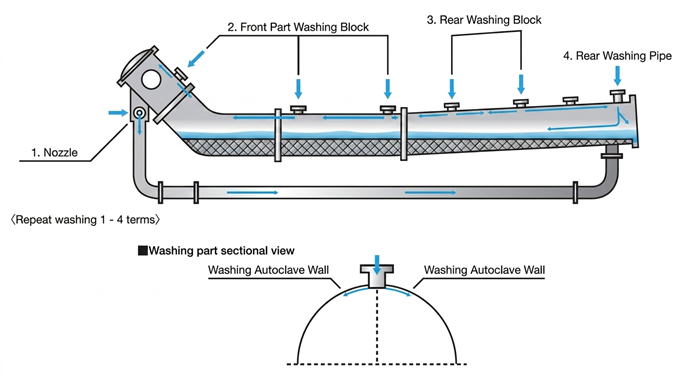
The Hisaka LLR System uses four strategically positioned washing components to clean the tank efficiently:
These components work together to repeatedly wash the tank surface through 1-4 washing terms, ensuring complete coverage with minimal water volume.
LLR employs a two-stage washing strategy for optimal cleaning:
LLR system reduces total washing time by more than 30-50% (from 100 to 39 in comparative tests). By eliminating tank filling and draining cycles and using targeted spray nozzles, the system completes tank cleaning in a fraction of the time. This means shorter downtime between dyeing batches and increased production capacity.
The primary advantage of LLR is dramatic reduction in water consumption - 67% less water (from 100 to 33) compared to conventional tank filling methods. For facilities running multiple dyeing batches daily, this translates to substantial water savings and significantly lower utility costs.
With 67% less water to heat (from 100 to 33), LLR delivers proportional steam savings. This is especially significant for facilities using hot water cleaning cycles. Reduced steam consumption means lower energy costs and reduced carbon footprint.
LLR system reduces electricity consumption by 61% (from 100 to 39) through shorter pump operation times and elimination of extended filling/draining cycles. Lower electricity usage contributes to overall operational cost reduction and improved sustainability metrics.
The strategically positioned spray nozzles (Nozzle, Front Part Washing Block, Rear Washing Block, Rear Washing Pipe) ensure complete coverage of all interior tank surfaces. The system repeatedly washes the tank surface physically through 1-4 washing terms, effectively removing dye dirt from every batch and preventing dirt accumulation.
LLR supports green manufacturing initiatives by minimizing water, steam, and electricity consumption. The system contributes to energy saving and environmental improvement, helping textile manufacturers meet environmental regulations, improve sustainability ratings, and demonstrate corporate responsibility.
Hisaka LLR System is ideal for textile dyeing facilities that:
Based on Hisaka testing data, the LLR System delivers measurable improvements across all key performance metrics compared to conventional tank cleaning methods:
| Performance Metric | Conventional Method | HISAKA LLR Method | Improvement |
|---|---|---|---|
| Total Time | 100 | 39 | 61% faster |
| Water Use | 100 | 33 | 67% less |
| Steam Use | 100 | 33 | 67% less |
| Electricity Use | 100 | 39 | 61% less |
💡 Key Insight: The LLR System delivers consistent 60-67% reductions across all resource consumption metrics. For a facility running 10 batches per day, this translates to 670 units of water saved daily, 670 units of steam saved, and 6.1 hours of production time recovered.
| Feature | Specification |
|---|---|
| System Type | Standard equipment on all new Hisaka jet dyeing machines (previously optional) |
| System Components | 1. Nozzle, 2. Front Part Washing Block, 3. Rear Washing Block, 4. Rear Washing Pipe |
| Washing Method | Shower spray system - repeated physical washing of tank interior surface |
| Washing Terms | Repeat washing 1-4 terms for complete coverage |
| Washing Process | Stage 1: Rinsing with remained water + Stage 2: Preventive washing during next preparation |
| Time Reduction | More than 30-50% faster (61% total time reduction: 100 → 39) |
| Water Savings | 50-70% reduction (67% in tests: 100 → 33) |
| Steam Savings | 50-70% reduction (67% in tests: 100 → 33) |
| Electricity Savings | More than 30-50% reduction (61% in tests: 100 → 39) |
| Compatibility | Hisaka jet dyeing machines (CUT Series) |
LLR is now standard equipment on all new Hisaka jet dyeing machines (CUT-ZR, CUT-CZ, CUT-XF, CUT-CF, CUT-AR, CUT-CJ, CUT-XFJ). Hisaka recognizes the critical importance of water and energy efficiency in modern textile manufacturing, making LLR a standard feature rather than an optional upgrade. When you purchase a new Hisaka dyeing machine, LLR is already included at no additional cost.
LLR is a mature, proven technology implemented in Hisaka dyeing machines worldwide. The system has been tested and optimized over years of real-world operation in diverse textile manufacturing environments, delivering consistent 60-67% reductions in water, steam, and electricity consumption.
Since LLR is standard on new machines, customers benefit from immediate cost savings from day one of operation. There is no additional investment required and no retrofitting needed. The system starts delivering 61-67% reductions in operational costs from the first batch, ensuring instant return on investment.
📞 Phone: (022) 7810889
📱 WhatsApp: +62 816 420 9650
✉️ Email: silvanus@tiaraservice.com