PT. TIARA SERVICE CENTRE
Hisaka UHT Testing Machines are compact, pilot-scale sterilization systems designed for research & development, formulation trials, and scalability evaluation. Instead of risking full production lines during new product testing, manufacturers can validate heat profiles, verify sterility, and optimize recipes using lab-friendly units that mirror commercial technology.
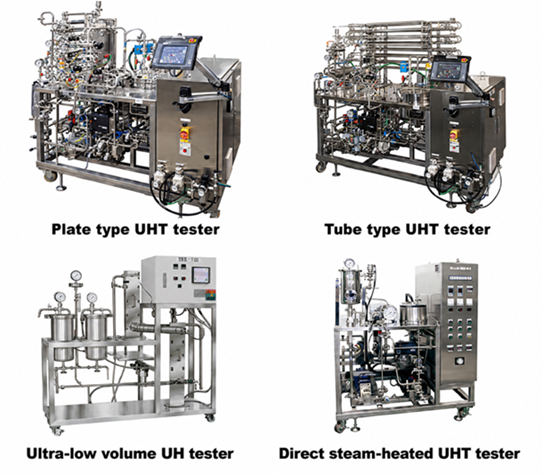
Hisaka offers 4 distinct testing systems, each matching a specific production method. Choosing the right tester ensures your R&D data accurately translates to full-scale manufacturing.
Purpose: Scalability evaluation and compatibility testing with production-scale plate heat exchangers.
Processing Volume: 40–60 L/H
Temperature Range: Sterilization 95–140℃, Cooling 85℃ / 30℃
Best for: Thin, low-viscosity liquids — milk, juice, tea, coffee, soy milk, clear broths, and alcoholic beverages.
Why choose this: Mirrors the exact heat transfer mechanism of production plate sterilizers. Results from this tester translate directly to full-scale plate-type RMS lines, making it ideal for scalability studies and process validation.
Purpose: Minimizes liquid loss and suppresses fragrance deposition during testing.
Processing Volume: 40–60 L/H
Temperature Range: Sterilization 95–140℃, Cooling 85℃ / 30℃
Best for: Viscous liquids and products with small particles — sauces, soups, purees, jam, custard, and beverages with pulp.
Why choose this: Large-diameter tubes prevent clogging and handle high-viscosity products smoothly. The design minimizes product hold-up (less waste) and prevents aromatic compounds from depositing on plate surfaces, making it ideal for testing premium-flavored products.
Purpose: Simple UHT testing with a very small amount of sample solution.
Processing Volume: 5 L/H
Temperature Range: Sterilization 95–140℃, Cooling 30℃ (manual operation)
Best for: High-value, limited-quantity samples — rare ingredients, early-stage formulations, expensive extracts, and small-batch specialty products.
Why choose this: Only needs 5 liters per hour — the smallest sample requirement of all testers. Perfect for early R&D when you only have a few liters of prototype. Manual cooling operation gives the operator full control over the cooling profile.
Purpose: Test newly developed spin-injection sterilization and compare with direct steam heating.
Processing Volume: 30–60 L/H
Temperature Range: Sterilization 95–155℃, Flash Cooling 85–60℃
Best for: Products requiring ultra-high temperature processing (up to 155℃) and flash cooling — dairy-based beverages, UHT milk, cream products, and heat-sensitive liquids.
Why choose this: Includes a steam injection system, enabling direct steam heating tests. Since an injection module is included, you can also run comparison tests between direct steam heating and spin-injection methods on the same unit. Reaches higher temperatures (155℃) than other testers.
| Tester Type | Volume | Sterilization Temp | Cooling | Best For |
|---|---|---|---|---|
| Plate Type | 40–60 L/H | 95–140℃ | 85℃ / 30℃ | Thin liquids, scalability testing |
| Tube Type | 40–60 L/H | 95–140℃ | 85℃ / 30℃ | Viscous products, minimal loss |
| STS-100 (Ultra-Low) | 5 L/H | 95–140℃ | 30℃ (manual) | Small samples, high-value products |
| Direct Steam-Heated | 30–60 L/H | 95–155℃ | 85–60℃ (flash) | Ultra-high temp, steam injection tests |
Using the correct tester follows a clear R&D pathway:
Test different recipes and target temperatures using small batches. STS-100 needs only 5L/H for early-stage prototypes.
Adjust temperature, flow rate, and holding time to find the perfect balance between safety and quality.
Collect samples for lab testing. Verify commercial sterility and track quality changes over time.
Once parameters are locked, scale directly to full production lines with zero guesswork.
Develop new products, reformulate existing recipes, or validate shelf-life before committing to full production runs.
Study heat transfer behavior, evaluate ingredient stability, and generate technical data for regulatory submissions.
Train students, conduct food science research, and publish studies on novel processing techniques.
Test client formulations, prove process viability, and build trust before scaling to commercial batches.
Test with 5–60L/H instead of 1,000L+ production batches. Failed trials waste minimal ingredients and money.
Real thermal profiles, flow rates, and sterility results replace guesswork and theoretical calculations.
Optimize recipes quickly, validate safety early, and launch products with confidence.
Testing machines use the same core technology as production lines, ensuring parameters transfer directly.